Rupert Brooke Society Launches the ‘Fairy
Gold’ Appeal
Sir Andrew Motion,
former Poet Laureate: 'Fairy Gold'
is a beautiful and rare work by Phyllis Gardner – and worth
treasuring for its own sake. The fact that it encodes her
feelings for Rupert Brooke gives it an even greater significance
- one that deserves to be widely recognised.
Dr Nicholas
Marston, King’s College, Cambridge: 'King's is very pleased to be able to help
the Rupert Brooke Society in its efforts to secure this
important and very touching painting. That it might eventually
join Brooke's own portrait in the college of which he was an
undergraduate and Fellow seems highly appropriate.'
Professor Jon
Stallworthy, Rupert Brooke Trustee, biographer and poet: 'Under seal' in a
national library for 51 years, 70 letters between Rupert Brooke
and Phyllis Gardner, and the young painter's 91-page memoir of
her passionate friendship with the poet, now await publication.
The emergence of this 'bright star' in his firmament made an
impact easily understood with the re-emergence of her beautiful
self-portrait, 'Fairy Gold'.
We must support the generous initiative of
the Rupert Brooke Society, and King's College, Cambridge, to
keep it in England and the public domain.
The Rupert Brooke Society and King's College, Cambridge, have
joined forces to launch the "Fairy Gold" Appeal. We have until
June to raise the £12,000 needed to purchase this beautiful
painting.
Fortunately, a large donation has
already been given and the Rupert Brooke Trustees will
also be donating to the Appeal, but this means we still
need to raise nearly £8000.
King's would love to add "Fairy
Gold " to their impressive Brooke archive, where it will be kept
safely and made available to those who want to see it. So we are
turning to all our members and admirers of
Rupert Brooke and Phyllis Gardner in the hope that you will want
to help secure this painting for future generations to enjoy,
rather than see it disappear in to a private collection.
A special A5 sized card has been produced by
the RBS and will be issued to those who donate at least £10 (£12
outside the UK to allow for postage costs)
to the Appeal.
‘Fairy Gold’ is featured on one side and acknowledgment of the
donation is given on the reverse.
A book listing all donors will also be kept
and handed to King's College. King‟s also plan to place a plaque
beneath the painting, acknowledging the Rupert Brooke Society's
key role in purchasing it. So now is your chance to claim a
little place in history.
You can donate by sterling cheque, using the slip
provided Please Note: The Rupert Brook Society is
unable to cash cheques that are in Euros or
currencies other than UK Sterling. We apologies for this
inconvenience.
Or you can visit the RUPERT BROOK SOCIETY
WEBSITE:
www.rupertbrooke.com and
make a donation via the Paypal link.
We know it is financially a tough time for a
lot of people at the moment but if we come together and donate
what we can, this is a goal that can be achieved.
The story behind the painting:
'Fairy Gold' was painted by Phyllis Gardner
in 1913 and exhibited and sold at the New English Exhibition
(Winter) in the same year. It measures 5ft by 2ft 7in, is in
watercolour and appears to be in its original gilt frame. It is
a self- portrait of Phyllis Gardner, symbolizing her feelings on
her love affair with the famous War Poet Rupert Brooke, likening
Brooke, or her relationship with him, to Fairy Gold. The
paintings title alludes to fairy legends where they use magic to
disguise appearance. Fairy Gold is notoriously unreliable,
appearing as gold when paid, but it soon turns into leaves or a
variety of other worthless objects.
It is important to provide some provenance
for this painting as this greatly adds to its significance: On
10 March 2000, the head curator of The British Library
Manuscripts Department unwrapped a sealed parcel which contained
what she described as: "without doubt, the most exciting
documents I have ever dereserved".
For over 85 years the correspondence of over
a hundred letters between Brooke and Gardner dating from 1912 to
1915, and a memoir by her laying bare with moving honesty the
details of their affair from beginning to end had been kept a
secret by a 50-year embargo that had been placed on them due to
their intimate nature.
Lorna Beckett was chosen by the Rupert Brooke
Trustees, Professor Jon Stallworthy and Andrew Motion, to edit
the letters and memoir; the book has been completed and should
be published in the not too distant future, until then, little
is known publicly about this relationship and in particular
Phyllis Gardner.
Brooke and Gardner met in 1912, he was
studying at King's College, Cambridge, lodging at Grantchester
in the Old Vicarage, and his first (and
only during his lifetime) volume of poetry entitled
Poems
had just been published. She was studying at the Slade
and at the Frank Calderon School of Animal Painting. Brooke
wrote his poem 'Beauty and Beauty' for Phyllis, recalling a
moonlight tryst they had at Grantchester.
Rupert to Phyllis :
Beauty and Beauty
When Beauty and Beauty meet
All naked, fair to fair,
The earth is crying-sweet,
And scattering-bright the air,
Eddying, dizzying, closing round,
With soft and drunken laughter;
Veiling all that may befall
After—after—
Where Beauty and Beauty met,
Earth’s still a-tremble there,
And winds are scented yet,
And memory-soft the air,
Bosoming, folding glints of light,
And shreds of shadowy laughter;
Not the tears that fill the years
After—after—
1912.
Grantchester
Tuesday night. [1912]
In bed
Well, you strange Phyllis, what I'd
wanted to say was this: you are incredibly beautiful
when you're naked, and your wonderful hair is blowing
about you. Fire runs through me, to think of it. You
devil, I remember every inch of you, lying there in that
strange light. “Primitive”. . . did you know what you
were saying, child, when you said “Why shouldn't we be
primitive, now?”? God, it was a hard struggle in me,
half against half, not to be. Sudden depths got moved –
But it wouldn't have done. Its fine to be “primitive”,
in a way: finer than merely a modern person. But there'
s something finer yet – the best of each – beast and
man. Oh, it's difficult writing. But you seem so queerly
to understand – and face things. Sometimes I think I
know you right through; better than anyone in the world
knows you – […]
Phyllis to Rupert:
[…] you are
so fine: bodily, mentally, spiritually. It's a wonderful
thing for you to tell me I'm fine: I can believe it
easier from anyone who's demonstrably not so good a
specimen as myself. You're built of fire, and you must
be perfectly free. You belong to nobody, as you said.
But when all's said I feel as if I too were built of
fire and for liberty: if circumstances say the reverse I
must acquiesce I suppose outwardly. But if I weren't
built like that I could have no sort of sympathy with
you. Don't you see that? Oh damn - this is all so hard
to put. I can't. I'll wait till you write and see what
you say. Meanwhile, best beloved, blessings be on you: a
curse be on any evil thing that dare touch a hair of
your head. - I could be an avenging savage for your
sake: and I always thought I didn't understand revenge.
There is a saying “every woman is at heart a savage” -
every man too I suppose-. I love the poem. It has a way
of ringing through one's head. You're a fine singer.
Write soon.
Phyllis
In 1913 things deteriorated between them when
Gardner refused to consummate their relationship without
further commitment from Brooke, he then
left for America to write articles for the
Westminster Gazette.
It was at this time Gardner painted 'Fairy Gold', which
was a significant painting for her both because it symbolizes
her feelings about her relationship with Brooke and it was the
first painting she had accepted for a New English exhibition, it
is also the only painting she mentions by name in her memoir
(written in 1918):
I set to
work and produced a picture which was accepted, and hung
in a good position, at the New English. This was the
first success of this kind I had had. The picture was called “Fairy Gold”.
And represented a young woman
standing in an autumn wood, sadly looking down at a
lapful of dead leaves. Some person unknown bought it,
and I have not seen it since.
The poet Robert Frost, who was a friend of
the Gardner family, even refers to this painting and Gardner's
foundering relationship with Brooke in a note to his friend John
T. Bartlett:
We know this
hardly treated girl oh very well. Her beauty is her red
hair. Her cleverness is in painting. She has a picture
in the New English Exhibition. Her mother has written a
volume of verse in which he gets his. Very funny. No one
will die.
Brooke and Gardner
continued to correspond until his death in 1915, Phyllis always
hoping until the end that Rupert would return to her.
This is probably the first time this painting
has surfaced since it was sold in 1913. It is believed that the
setting among the beech trees is a location near to Phyllis'
home in Tadworth, Surrey, where Brooke and she walked. Gardner's
artwork hardly ever appears on the market, so it is very
exciting that this key painting has been discovered.
Please donate to the ‘Fairy Gold’ Appeal
today.
Thank you.
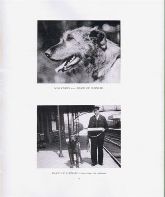
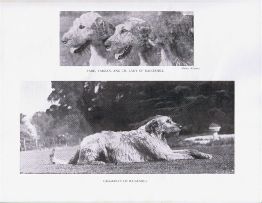
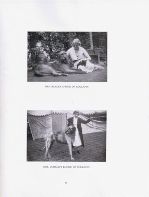
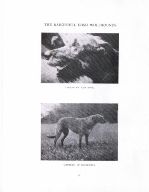
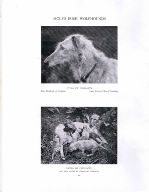
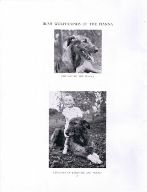
Phyllis Gardner with one of her beloved Irish Wolfhounds, 1934.
THEIRISHWOLFHOUND
AShortHistorical Sketch By
Phyllis Gardner
With over one hundred wood
engravings specially cut
by the author and her sister Delphis Gardner First published1931
In addition to the standard Edition, a Limited Edition of Fifty
Copies printed on hand-made paper, signed by the Author were published.
Limited Edition No 28 signed to Dr Roche
by Lady Joyce Talbot de Malahide
Phyllis Gardner’s
THE IRISH WOLFHOUND (1981 Edition)
Was reprinted in 1981 by E C
Murphy
with permission of Dundalgan Press
THE IRISH WOLFHOUND
A Short Historical Sketch
By Phyllis Gardner